

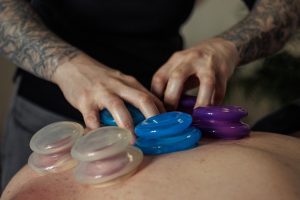
Cupping therapy has been used for thousands of years worldwide in various healing settings and spiritual ceremonies. It is regaining popularity among healthcare professionals as an effective manual therapy treatment that increases blood circulation and lymphatic flow, improves range of motion, and effectively treats musculoskeletal pain (Furhad et al., 2023; Warren et al., 2020; Wood et al., 2020). There are several types of cupping treatments; Elizabeth specialises in a non-invasive dry cupping technique known as myofascial decompression (MFD). This myofascial release technique uses negative pressure to pull the tissue up rather than using positive pressure to push it down. It is especially helpful for treating stubborn adhesions that reduce mobility in areas like the back, legs, shoulders, arms, neck, and chest. Studies confirm this method can release tension as effectively as traditional myofascial release methods with greater results in less time (Warren et al., 2020).
What to Expect
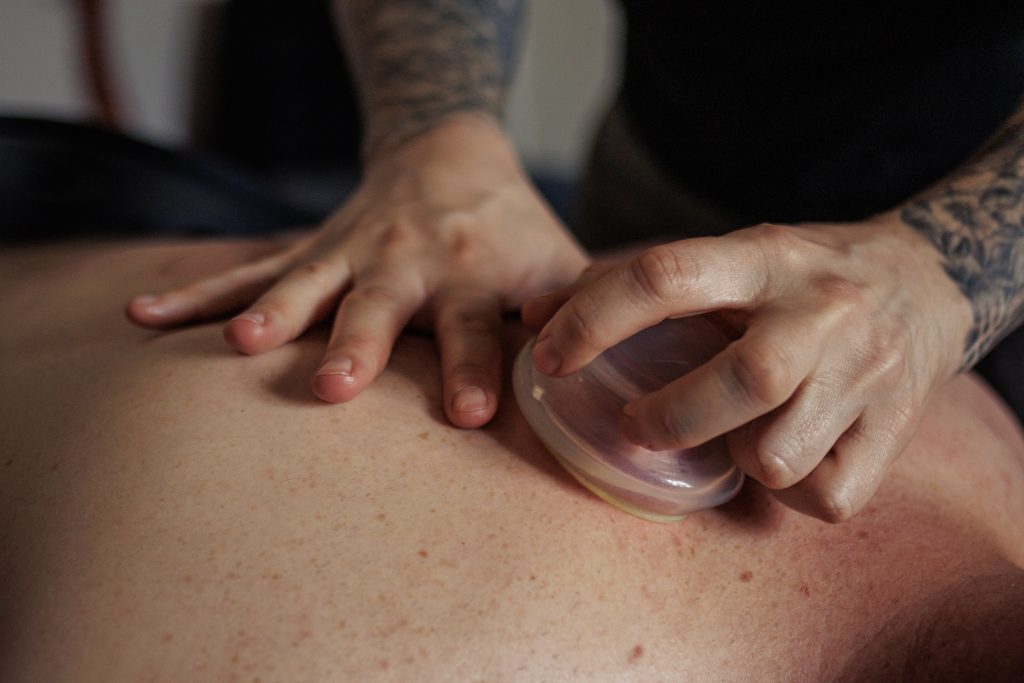
Static cupping includes placing silicone cups on an area for 5-10 minutes, while dynamic cupping involves moving the cups on the skin. This sensation may cause mild discomfort but shouldn’t be painful. Sometimes clients experience atypical sensations such as itching or tingling while cups are applied. The massage therapist will check in with the client regularly to make sure the cups are not on too tight. They may also use sports massage techniques such as incorporating movement into the treatment process to facilitate myofascial release. After treatment, clients often report “feeling lighter” and having improved posture, increased joint mobility, and decreased pain.
Dry cupping therapy is a safe treatment for most people but is not suitable for someone who bruises easily or has a bleeding disorder, deep vein thrombosis, haemophilia, organ failure, cancer, or is taking anti-coagulant medication (Furhad et al., 2023). Unique circular bruising called ecchymosis may linger post-treatment and, though not painful, can last up to a week. The severity of these bruises and recovery time depends on a variety of things including the body part treated, tissue perfusion, hydration, severity of adhesion prior to treatment, how long the cups were applied, etc. If you have any questions or concerns regarding cupping therapy, feel free to speak to your massage therapist prior to your treatment or contact support@camdoonen.com.
References
Furhad, S., Sina, R. E., & Bokhari, A. A. (2023). Cupping Therapy. Nih.gov; StatPearls Publishing. https://www.ncbi.nlm.nih.gov/books/NBK538253/
Warren, A. J., LaCross, Z., Volberding, J. L., & O’Brien, M. S. (2020). ACUTE OUTCOMES OF MYOFASCIAL DECOMPRESSION (CUPPING THERAPY) COMPARED TO SELF-MYOFASCIAL RELEASE ON HAMSTRING PATHOLOGY AFTER A SINGLE TREATMENT. International journal of sports physical therapy, 15(4), 579–592. https://pmc.ncbi.nlm.nih.gov/articles/PMC7735689/
Wood, S., Fryer, G., Tan, L. L. F., & Cleary, C. (2020). Dry cupping for musculoskeletal pain and range of motion: A systematic review and meta-analysis. Journal of bodywork and movement therapies, 24(4), 503–518. https://doi.org/10.1016/j.jbmt.2020.06.024